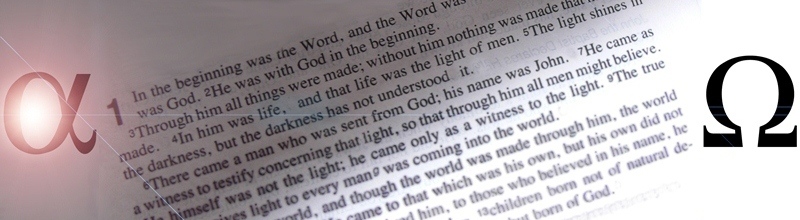
JESUS CHRIST, THE WORD,
ETERNAL SON OR EVERLASTING (ETERNAL) FATHER?
- ETERNAL SONSHIP OR INCARNATIONAL SONSHIP?
The long-running debate on whether Eternal Sonship or Incarnational Sonship is the true, Scriptural view of Christ’s Deity and Sonship reveals commendable zeal for the truth about Him by both sides, but it is regrettable that such serious differences exist. Could they be due to underestimating the corrupting effect of pagan philosophy upon early church theologians and their misunderstanding of Scripture? Please take a fresh look at this crucially important issue and let us try to resolve these differences in a gracious spirit:
What Saith the Scripture?
The orthodox doctrine of the Trinity as summarised in the final, AD 381, version of the Nicene Creed, the great Creed of Christendom, states that Christ, the Word, is “the only-begotten Son of God, begotten from the Father before all ages,” i.e. in eternity past, so He is known as ‘The Eternal Son.’ The orthodox doctrine of the Holy Spirit states that He was spirated by and proceeded from God the Father via the Son. But are these twin doctrines, implying that both the Word and the Holy Spirit were derived from God the Father in eternity past, clearly taught in Scripture and has the church always held them? Bearing in mind that “In the beginning was the Word…and the Word was God… All things were made by Him; and without Him was not anything made.” (Jn.1:1,3) – He is our awesome Creator God who made all things so magnificently! – please consider prayerfully and reverently the profound implications of these crucially important declarations by our Lord Jesus Christ, the Word:
|
“Verily, verily, I say unto you, Before Abraham was, I AM.” (John 8:58)
and
“I AM Alpha and Omega, the Beginning and the End, the First and the Last.” (Revelation 22:13)
|
which reveal His greatness and glory as fully, truly and eternally God in His own right – as also is the Holy Spirit, “the Spirit of God” (Rom.8:9), “the eternal Spirit” (Heb.9:14). Compare John 8:58 with Exodus 3:14,15 where Yahweh Elohim, the Lord God, the triune Godhead told Moses to say “I AM” had sent him. Clearly, Christ, the Word’s claim to be “I AM” is a claim to be self-existent, i.e. un-derived! – and to deny His self-existence is a very serious matter (see John 8:24). None of the Three self-existent Divine Persons had any need to be ‘begotten’ or ‘spirated,’ for each is fully and truly God in His own right, co-eternal, co-self-existent and co-equal in the One triune Godhead. If Christ, the Word, is “The First” as God, no other Divine Person could have been before Him to beget Him. The only way Christ, the Word, could have been ‘begotten’ was by ‘emptying’ Himself in order to become incarnate as a Man. (Phil.2:5-8) – He was eternally “in the form of God”, but at His Incarnation He “took upon Him the form of a servant and was made in the likeness of men.” He could not have been begotten nor die as God, so He became a Man for our sakes, to be able to save us by dying for our sins on the Cross (2 Cor.8:9). Prior to His Incarnation He was named as: “The Mighty God, The Everlasting (i.e. Eternal) Father” (Heb. Ad Ab, Isaiah. 9:6). How can He be both Eternal Father and Eternal Son? |
The Word is “the second man…the Lord from heaven.” (1 Cor.15:47). If He is “the Second” as Man, He must be “The First” as God and “the Lord (i.e. Yahweh) from heaven.” Before He became “the Second Man” at His incarnation, He was eternally “Alpha… The Beginning… The First…” as God! “Eternal” means “everlasting: without beginning or end” (cf Psalm 90:2) and “son” means “male offspring…descendant.” Clearly, anyone who has always been a “son,” a “male offspring,” must have had a beginning, so could not have had existence “without beginning or end,” so could not be eternal, nor self-existent, nor God! But The Word, was not only “in the Beginning,” but He Himself is “The Beginning…The First,” the eternal, self-existent “I AM” whose existence is “without beginning or end.” As God He had no beginning, so could not always have been the “male offspring,” the “Son” of God the Father! With the greatest respect, since ‘eternal’ means ‘everlasting: without beginning or end’ and ‘son’ means ‘male offspring,’ is not combining those two words in a title never, ever used in Scripture, ‘Eternal Son,’ clearly a contradiction in terms, illogical and meaningless? – surely, there can be no such person as an Eternal Son! The Holy Spirit is named as “the eternal Spirit” (Heb.9:14), so He also must be “I AM” and “The First,” eternal and self-existent – for only a Divine Person who is self-existent (i.e. un-derived) and fully and truly God in His own right could be truly eternal.
In the Old Testament, (a) there is no unambiguous mention of a Divine “Son of God”, only exceedingly rare (less than 10) unambiguous mentions of a Divine “Son” – all prophetic, referring to One yet to come. (Ps.2:7: “Thou art my Son; this day have I begotten thee,” is prophetic of the Incarnation, as it refers to a “day” in the ‘time’ era – there were no days in eternity past!); (b) the Holy Spirit is often mentioned, but the Name, ‘God the Father,’ is never, once used and mentions of a Divine Father are exceedingly rare (less than 10), all but one referring to Yahweh Elohim, the triune Godhead, or to the pre-incarnate Word Himself (Is.9:6) as Father to humanity, or to Israel, in the creatorial sense; (c) there is no unambiguous mention of a then-existing Divine Father-Son relationship – only of one yet to come in the future, e.g. the prophetic Divine promise in 2 Sam.7:14, the exception mentioned in (b) – applied to God the Father and Christ as Son in Heb.1:5b – which is in the filiation sense and the future tense, and was not fulfilled until the Incarnation! Even without any other proof, the latter is surely proof enough that the Divine Father-Son relationship did not commence until then! If there was a Divine Father-Son relationship prior to the Incarnation, why is the Old Testament not as full of references to it as the New? – instead, there are only a miniscule number of prophetic references to it! Since God the Father is not so-named until after the Incarnation, the only reasonable answer is that such a relationship did not previously exist.
The crux of this issue is: whether the Word and the Holy Spirit were derived from God the Father in eternity past? Surely a derived God could not be a true God – a true God must be un-derived, and not dependent upon any other Being for His existence. In declaring: “…before Abraham was, I AM” the Word was claiming to be eternal and self-existent, i.e. un-derived, so was not dependent upon another Being for His existence! How could it be written of Him that “in Him dwells all the fulness of the Godhead bodily” (Col.2:9), unless He ever was, is now, and for ever will be, fully and truly God in His own right, eternal and self-existent, i.e. un-derived, and co-eternal, co-self-existent and co-equal with God the Father and the Holy Spirit in the One awesome triune Godhead, Yahweh Elohim? Rev. William Romaine, one of the four most important leaders of the 18th century Evangelical Revival, affirmed in his 1755 sermon, The Self-existence of Jesus Christ: “In the unity of the divine essence there are Three Persons equal in all perfections and attributes, so that none is before or after other, none is greater or less than another, but the glory is equal, the majesty co-eternal… The ever-blessed Trinity took the names of Father, Son and Holy Spirit, not to describe in what manner they exist as divine Persons, but in what manner the divine Persons have acted for us men and for our salvation… The terms Father, Son and Holy Spirit are terms of economy, and are accordingly used in Scripture to describe the distinct parts, which the ever-blessed and adorable Trinity sustained in our redemption… whoever is self-existent is the true God, but Christ is self-existent, therefore He is the true God… Christ is the great and eternal I AM, true and very God, equal in all things with the Father and the Holy Spirit as touching His Godhead.”
The Strong Influence Of Pagan Philosophy On Early Church Theologians
In his classic study, Early Christian Doctrines (A & C Black, 5th Edn, 1977), J.N.D. Kelly says that the godly, martyred Ignatius (35-107), Bishop of Antioch, wrote of Christ: “In His pre-existent being ‘ingenerate’… His divine Sonship dates from the incarnation.” Kelly comments: “In tracing His divine Sonship to His conception in Mary’s womb, he was simply reproducing a commonplace of pre-Origenist theology…” (pp.92/3). Thus, the 1st/early 2nd century church held the ‘Incarnational Sonship’ doctrine. So how did the ‘Eternal Sonship’ doctrine originate? In an article in the Winter 2001 issue of the journal, Churchman, Prof. Paul Helm, the eminent evangelical theologian and scholar, Emeritus Professor of the History and Philosophy of Religion, King’s College, London University; Chairman of Trustees of the Evangelical Library, London, England 1998-2006; made a “plea for the removal from our understanding of the doctrine of the Trinity of certain concepts which derive not from the New Testament but from pagan philosophy, from Neoplatonism. The plea is made in order that our understanding of the Trinity may be more faithful to Scripture…” Prof. Helm identified these “certain concepts” by saying, “There is no question but those who formulated the doctrine of the Trinity in terms of the begetting of the Son and the processing of the Spirit were influenced by Neoplatonism, particularly by the idea that from the One* emanated Mind and Soul (corresponding to the begottenness and procession of the Son and the Spirit)…” (* i.e. the Ultimate “ONE” of pagan philosophy). (An audio recording of Prof. Helm’s important lecture, Cautious Trinitarianism, at the John Owen Centre, The London Theological Seminary on 12/2/2001, is obtainable from them – Tel: 020 8346 7587).
How then did the doctrine of the Trinity become corrupted by pagan philosophy? Kelly’s reference to “pre-Origenist theology” is a clue. In the 2nd-5th centuries theologians increasingly ignored the Scriptural warnings against philosophy (Col.2:8), mere human ‘wisdom’ (1 Cor.1:19-31) and false teachers from without and within the church (Acts 20:27-31). Origen (185-254), though never properly ordained to any office in the church, rose to prominence due to his great learning and is regarded as the ‘first great Christian scholar.’ The Foreword to Origen: The Bible and Philosophy in the Third-century Church by Dr J.W. Trigg (SCM Press, 1985) also names him as “the first great theologian of the church,” and says “Origen and Augustine tower above all other figures in the history of early Christian thought.” Augustine (354-430) came too late to influence the doctrine of the Trinity, so Origen alone was the towering figure whose teachings had such a powerful influence upon it. Dr Trigg tells us: “The Platonic philosopher Ammonius Saccas…taught Origen and Plotinus” (founder of Neoplatonism), “the two most influential thinkers of the third century.” (p.66), so Origen was exposed to pagan philosophical concepts in his education. In his treatise “On First Principles…Origen quickly began to interpret the Christian faith in Platonic categories. The doctrine of God par excellence was the doctrine of God the Father since for Origen the Son and the Spirit are “God” only by attribution… Platonic categories also enabled Origen to arrive at a formula, ‘eternal generation’, to describe the Son’s relation to the Father… Origen, although he insisted on Christ’s Divinity…was unwilling to ascribe to the Son the same dignity he ascribed to the Father… The Son as a mediating hypostasis is inferior to the Father and represents a lower stage in the cosmological scale. Only the Father, Origen said, is truly God; the Son is God only by participation in the Father… The Son, for Origen, is not God but the image of God… Similarly, it is appropriate to pray to the Father through the Son but not to the Son by himself… as long as he dealt with the Son’s relation to the Father and his role as a cosmological principle, Origen found it easy to be simultaneously a Christian and a Platonist.” (pp.95-99).
Dr Trigg refers to “the extraordinary power of Platonism over Origen’s thought, a power greater than he himself was aware… He does not always seem…aware…of the extent to which Platonism molded his understanding…” (p.74). So in blatant disobedience to the stern Scriptural warnings against philosophy and mere human ‘wisdom,’ Origen “found it easy to be simultaneously a Christian and a Platonist,” and as a result, his thought became dominated by the concepts of pagan philosophy, which was disastrously wrong for the “first great theologian of the church” revered by the vast majority of 3rd - 5th century theologians. Surely this ‘extraordinary power…over Origen’s thought’ was not the power of the Holy Spirit! Clearly, it opened the door for pagan philosophy to influence and corrupt Christian doctrine. “Hyppolytus, the Roman theologian who was Origen’s older contemporary, saw philosophy simply as a breeding ground for error and attempted to demonstrate how each Christian heresy took root in the tenets of a particular philosophical school.” (p.71). “Soon Origen’s use of philosophy and allegorical interpretation of the Bible exposed him to criticism from…anti-intellectual Christians.” (p.91). “…after the Council,” (of Constantinople, 381) “Epiphanius (c 315-403), bishop of Salamis…the chief city of Cyprus, published a scathing denunciation of Origen in his Panarion or Medicine-Chest for all Heresies. He depicted Origen as the main source of the recently defeated Arian heresy…” (p.250) – which the writer believes is a fair comment. In his God Being History (Elsevier, 1975, p.89), Dr E.P. Meijering confirms Dr Trigg’s statements by writing: “It is well-known that Origen’s doctrine of the Father as the ground of divinity represents a hierarchic conception of the Divine which betrays Platonic influence.” In his helpful book, Creeds, Councils and Christ (Mentor, 1997, p.78), Prof. Gerald Bray sums up Origen’s life’s work thus: “Origen’s writings are handicapped by a fatal flaw which pervaded the whole of his work and compromised its value…his commitment to Platonism. His writings were eventually condemned because of his platonic view of the soul.” In AD 543 Origen was posthumously condemned as a heretic and excommunicated for the latter, and for his teaching that all human beings, and even the devil and his demons, will ultimately be saved! – the heresy of Universalism.
Based on his view that “Only the Father…is truly God,” which demotes the Word and the Holy Spirit to an inferior status and implies that They are not fully and truly God, Origen equated the singular Ultimate ‘ONE’ of pagan philosophy with God the Father, saying “only” He is “unbegotten” and “the existence of the Son is generated by Him.”! (Origen de Principiis, Bk.1, Ch.2, p.23); also “Origen …basing himself on John 1:3…taught that the Spirit must be included among the things brought into existence through the Word.”! (Kelly, Ibid. p.263). So, Origen clearly believed that Christ, the Word and the Holy Spirit owe Their existence to God the Father – which obviously denies Their Deity and eternality. Also, as Dr Trigg said, “Platonic categories” enabled Origen to arrive at the formula of ‘eternal generation’, so this concept originated not in Scripture, but in Platonism! Prof. Louis Berkhof, in his Systematic Theology (Banner of Truth, 1958), confirms this by saying Origen was “one of the very first to speak of the generation of the Son” (p.93), so this doctrine dates only from the 3rd century, it was not “from the beginning”, so is not to “abide in” us (1 Jn.2:24,26)! Thus did Origen clearly originate the orthodox ‘Eternal generation and Sonship of Christ’ and ‘Spiration and Procession of the Holy Spirit’ doctrines, modified versions being ‘set in stone’ in the Nicene Creed by the 4th century embryonic Roman Catholic/Orthodox church, when popes were already established in Rome and theologians were still in awe of Origen, whom they revered as their great teacher. This major step-change in the orthodox doctrine of the Trinity is evident in that Alexander, Arius’s bishop at Alexandria, wrote of Christ: “He is not Himself a creature, being derived from the Father’s being. The Father alone is ‘ingenerate’, i.e. unoriginate or self-existent.” (Kelly, Ibid. p.224) – thus flatly contradicting the 1st century Ignatius who wrote that Christ was “In his pre-existent being ‘ingenerate’” (i.e. unoriginate or self-existent). Even more seriously, in saying that Christ, the Word, was “derived from the Father’s being”, he also flatly contradicted Christ’s own claims to be “The First” and the self-existent, i.e. un-derived, “I AM”.
Athanasius (296-373), principal architect of the Nicene Creed and successor to Alexander as Bishop of Alexandria (diocese of Origen and Arius), was also strongly influenced by pagan philosophy, as Dr E.P. Meijering tells us in Platonism in Athanasius: Synthesis or Antithesis? (E.J. Brill, 1974): “Athanasius makes use of the Middle-Platonic conception of God…he expresses his Christian faith largely in Platonic language and presuppositions.” (pp.126,146), adding in God Being History (Elsevier, 1975): “Athanasius…states firmly that the Son and the Spirit have their arch (origin) in the Father.” (p.89)! As God, the Word and the Holy Spirit are both eternally self-existent, so could not have had an ‘origin’! The Cappadocian theologian, Gregory of Nyssa (335-394), explained the Trinity thus: “the three Persons are to be distinguished by their origin: the Father being cause and the other two caused. The two Persons Who are caused may be further distinguished, for one of Them is directly produced by the Father, while the other proceeds from the Father through an intermediary.*” (* the Son. Kelly, Ibid, p.262). So, 4th century theologians believed that, in eternity past, the Word and the Holy Spirit were “derived from,” “caused,” “produced by” and “have their origin in the Father” – the Word was “begotten from the Father” as “Son of God” and the Holy Spirit “spirated”! If true, that would rob Christ, the Word, and the Eternal Spirit of Their eternality and self-existent Deity. So, due to the influence of pagan philosophy upon Origen and Athanasius, the 4th century church adopted the ‘Eternal Sonship’ doctrine in place of the ‘Incarnational Sonship’ doctrine held by the 1st/2nd century church. Thus, there was a major step-change in the doctrine of the Trinity during the 2nd – 4th centuries, and this step-change was not seriously challenged, nor corrected during the 16th century Reformation.
Conclusion and Appeal
Hebrews 10:25 calls upon Christians to exhort “one another and so much the more, as ye see the day approaching.” Events in the world, and especially the unprecedented upheaval in the Middle East and the threatened confrontation between the Arabic / Islamic nations and Israel, and many other developments in the world, suggest that Christ’s Second Coming could be very near. If so, that awesome ‘moment of truth’ when we must (ordained or not) stand before our Lord at His Judgment Seat to receive His assessment of the things done in the body (2 Cor.5.10), must also be approaching. How ashamed we shall be there if He has to point out that we had held doctrines about His and the Holy Spirit’s Divine Persons which, at least partly, had their origins in, so were corrupted by, pagan philosophy. We would surely risk our Lord’s rebuke, forfeiting His “well done” and any rewards we might otherwise have had for faithful service to Him (2 Jn.8). Then “many…first shall be last” (Mt.19:30) – so may none be complacent, but remember that “judgment must begin at the house of God” (1 Pet.4:17). May we heed Prof. Helm’s remarkable “plea” for the removal of the pagan philosophical “concepts” he mentioned from “our understanding of the Trinity” that it “may be more faithful to Scripture,” and may we “earnestly contend for the faith which was once delivered unto the saints.” (Jude v 3).
For a more comprehensive, in-depth study on this crucial subject, please follow this link to www.21st-century-reformation-of-trinity-doctrine.co.uk
Printable PDF Version
Brief, well-informed, sincere comments will be welcome – but it may be difficult for the writer to reply to extensive correspondence. E-mail him at Bernard.Reeves@21st-century-reformation-of-trinity-doctrine.co.uk - please give your e-mail or postal address, including postcode.
|